Designing an Azure Landing Zone for Workload Migration
A well-designed Azure landing zone provides the governed, repeatable foundation required to migrate, operate, secure, and scale workloads. This guide explains how to plan the management hierarchy, identity, networking, governance, security, operations, automation, and cost controls that support successful Azure adoption.
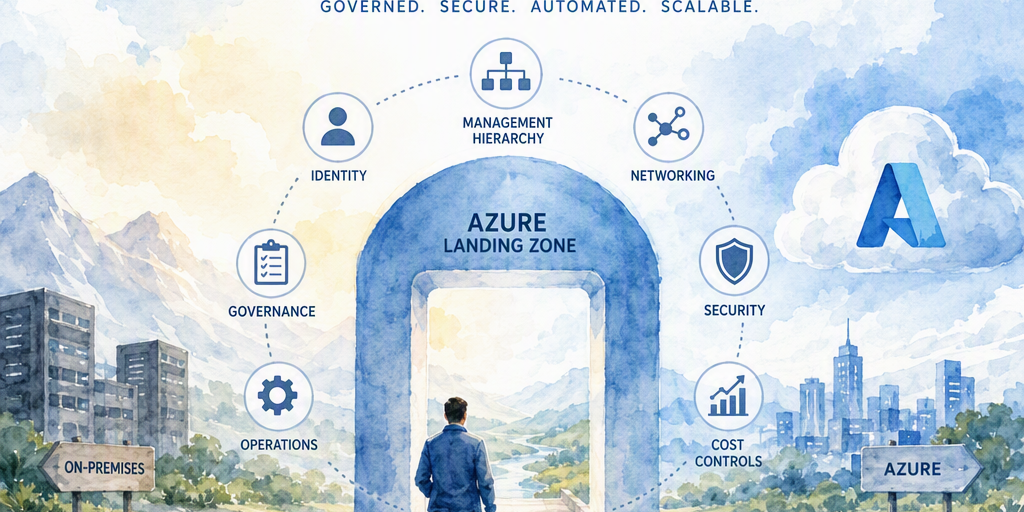
Successful Azure migration begins before the first virtual machine, database, or application is moved. It begins with a reliable foundation.
An Azure landing zone provides that foundation. It is a governed, repeatable environment where workloads can be deployed, operated, secured, and scaled. Rather than representing a single subscription or fixed reference architecture, a landing zone brings together the organizational hierarchy, identity model, network design, security controls, governance policies, management processes, and operational tools required for cloud adoption.
A thoughtfully designed landing zone helps organizations migrate with confidence. It reduces the likelihood of inconsistent configurations, unclear ownership, unmanaged access, weak monitoring, and unexpected costs. It also creates a platform that can support multiple migration approaches, including rehosting, replatforming, refactoring, container adoption, and the use of managed Azure services.
Why the Landing Zone Matters
Landing-zone design is one of the earliest and most influential decisions in an Azure migration. The choices made at this stage affect:
- Security, through identity controls, network segmentation, encryption, and threat detection
- Delivery speed, through reusable templates, standardized subscriptions, and automated provisioning
- Operational resilience, through monitoring, backup, disaster recovery, and documented processes
- Cost management, through ownership metadata, budgets, tagging, and rightsizing
- Scalability, through repeatable patterns for new applications, environments, and business units
- Governance, through policies and controls that remain consistent as Azure usage grows
Without an adequate foundation, migration teams may place applications into subscriptions with inconsistent policies, unsuitable address spaces, incomplete connectivity, or insufficient monitoring. These issues often remain hidden until after cutover, when they become more expensive and disruptive to correct.
A landing zone also clarifies responsibilities. Platform teams can manage shared services such as identity integration, connectivity, security tooling, and policy. Application teams can focus on workload configuration, deployment, performance, and business outcomes within approved boundaries. This separation reduces operational friction and creates a clearer accountability model.
A Foundation Rather Than a Migration Plan
A landing zone is not a migration wave plan, an application environment, or a substitute for workload discovery. It is the platform foundation into which applications and data services are deployed.
Migration planning and landing-zone design should progress together. Workload inventory, dependency mapping, and application assessments reveal the requirements that the platform must support. These may include:
- Connectivity to on-premises systems
- Private access to databases and platform services
- Integration with existing identity providers
- Regulatory or data-residency boundaries
- High availability across availability zones or regions
- Backup and disaster-recovery requirements
- Legacy protocols and address-space constraints
- Strict egress inspection or restricted internet access
- Specialized operating-system, licensing, or performance needs
A foundation designed without this information can create avoidable constraints. Conversely, a landing zone designed only around the first migration wave may lack the flexibility required for future workloads. The most effective approach establishes a secure minimum foundation, validates it with representative workloads, and expands it through controlled iterations.
Aligning the Design With Cloud Adoption Guidance
Microsoft's Cloud Adoption Framework for Azure presents landing zones as scalable architecture and implementation guidance rather than a universal template. Its enterprise-scale concepts can help organizations structure platform services, governance, security, networking, and operations across a growing Azure estate.
The Azure Well-Architected Framework provides complementary principles for evaluating workload and platform decisions across:
- Reliability
- Security
- Cost optimization
- Operational excellence
- Performance efficiency
These frameworks provide useful starting points, but the final design must reflect the organization's business requirements and operating model. A global enterprise with strict regulatory obligations will need different boundaries and controls from a smaller organization migrating a limited portfolio of internal applications.
The design should account for business ownership, regulatory scope, workload criticality, delivery practices, support capabilities, and the organization's tolerance for centralized versus delegated control.
Establishing the Management Hierarchy
Azure management groups can organize subscriptions and provide a consistent scope for applying governance. Subscriptions create important boundaries for billing, quotas, access control, policy assignment, resource organization, and operational separation.
A practical hierarchy should be understandable to the people who manage and use it. Common organizing principles include:
- Platform services versus application workloads
- Production versus nonproduction environments
- Business units or organizational ownership
- Regulatory or data-residency requirements
- Different operational or billing responsibilities
Management groups can make policies easier to apply consistently, but excessive hierarchy creates confusion and makes governance harder to maintain. A useful structure supports clear policy inheritance, delegated administration, reporting, and subscription placement without mirroring every detail of the corporate organization.
Developing a Subscription Strategy
Subscription placement should be deliberate. A subscription may represent a lifecycle, ownership, regulatory, or operational boundary. It may also support separate billing, quotas, access models, or deployment processes.
Many organizations separate shared platform services from application subscriptions. Platform subscriptions may contain:
- Connectivity and network security
- Identity-related integrations
- Centralized monitoring and logging
- Security management
- Shared automation
- Backup or recovery services
Application subscriptions can then contain workload resources under the ownership and lifecycle of specific teams. Production and nonproduction resources may be separated when different access, availability, or change-control requirements apply.
There is no universally correct number of subscriptions. Too few can create access, quota, and ownership challenges. Too many can increase administrative overhead and make policy, networking, and cost reporting more difficult. The strategy should remain simple enough to explain and flexible enough to evolve.
Designing Identity and Access From the Start
Microsoft Entra ID is central to authentication and authorization in Azure. Identity decisions should be established before migration rather than added after workloads are running.
A strong identity model includes:
- Group-based access instead of large numbers of individual assignments
- Least-privilege role assignments
- Clear separation between platform administration and workload administration
- Managed identities for Azure resources whenever possible
- Privileged access controls for elevated permissions
- Time-bound or approval-based administrative access where appropriate
- Processes for joiners, movers, and leavers
- Regular access reviews
- Separate identities or accounts for administrative activities
- Protection for service principals, certificates, and other nonhuman credentials
Role-based access control should reflect actual operational responsibilities. Application teams may need permission to deploy and manage resources within their workload scope without receiving broad access to network security, identity configuration, or other applications.
Privileged access should not rely on permanent, highly elevated permissions. Just-in-time elevation, approval workflows, multifactor authentication, and audit logging can reduce the risk associated with administrative accounts.
Identity integration also affects migration sequencing. Directory synchronization, authentication dependencies, legacy service accounts, application authentication methods, and access to shared file or database services should be assessed during discovery.
Building the Network Architecture
The landing zone defines how Azure connects to on-premises environments, branch locations, users, external services, and other clouds. Network decisions are among the most difficult to change after workloads have been deployed, making early dependency analysis essential.
Key design considerations include:
- Azure address-space planning
- Hub-and-spoke or Azure Virtual WAN architecture
- Routing and route propagation
- DNS resolution across Azure and on-premises environments
- Private endpoints and private DNS zones
- Firewall placement and traffic inspection
- Ingress and egress controls
- Segmentation between workloads and environments
- Connectivity to branches, partners, and external services
- Overlapping IP ranges in legacy environments
- Bandwidth, latency, and resilience requirements
A hub-and-spoke model commonly centralizes shared connectivity and security services in a hub while placing workloads in separate spoke networks. Azure Virtual WAN can provide another approach for organizations with distributed locations and large-scale connectivity requirements. The appropriate pattern depends on network scale, operational capability, routing needs, and the desired level of centralization.
Treating DNS as a Migration Dependency
DNS is frequently underestimated during migration. Applications may depend on internal hostnames, conditional forwarding, legacy name-resolution services, private endpoints, or hard-coded records. A workload that can reach a destination by IP address may still fail when its expected hostname cannot be resolved.
DNS design should define authoritative zones, forwarding paths, private DNS integration, ownership, and change processes. These decisions should be tested before cutover with representative application dependencies.
Planning Egress and Private Access
Outbound connectivity requires explicit design. Applications may need access to update services, external APIs, package repositories, monitoring endpoints, or identity services. Organizations may also require outbound traffic to pass through centralized firewalls or inspection services.
Private endpoints can reduce public exposure for supported Azure services, but they introduce additional DNS and routing requirements. Their use should be based on security, connectivity, and operational needs rather than applied indiscriminately.
Applying Governance Through Guardrails
Azure Policy can audit or enforce requirements across management groups, subscriptions, resource groups, and resources. Common policy areas include:
- Allowed Azure regions
- Required tags and ownership metadata
- Approved resource types and SKUs
- Encryption requirements
- Diagnostic settings
- Network exposure
- Private connectivity
- Security configurations
- Resource naming or location standards
- Use of managed identities
- Restrictions on public IP addresses
Policies should be introduced at an appropriate level of maturity. Audit policies can provide visibility while teams validate their impact. Enforcement can follow once requirements, exceptions, and remediation processes are understood.
Overly aggressive policies can block legitimate migration activity, particularly when legacy workloads do not immediately meet modern standards. A clear exception process should define who can request an exception, the evidence required, the approval authority, the exception's duration, compensating controls, and the review and expiry process.
Exceptions should be explicit and time-bound. They should not become a permanent substitute for remediation.
Establishing a Security Baseline
Security must be built into the landing zone and migration process. The baseline should align with organizational security standards, regulatory obligations, and incident-response capabilities.
Important elements include:
- Microsoft Defender for Cloud
- Vulnerability assessment and remediation
- Protection for secrets through services such as Azure Key Vault
- Encryption in transit and at rest
- Security logging and centralized analysis
- Threat detection and alerting
- Secure administrative access
- Network controls and segmentation
- Incident-response procedures
- Configuration and compliance assessment
Secrets should not be embedded in application code, deployment scripts, or infrastructure templates. Key Vault and managed identities can reduce the need for long-lived credentials and support more secure access patterns.
Security controls should be tested with real migration scenarios. A control that is technically correct but difficult to operate may be bypassed or generate excessive noise. Security, platform, and application teams should agree on alert ownership, response targets, escalation paths, and evidence requirements.
Making Operations Ready on Day One
A workload is not ready for production merely because it runs in Azure. It must also be observable, supportable, recoverable, and governed.
A production-ready landing zone typically includes:
- Centralized or coordinated logging
- Metrics and application performance monitoring
- Actionable alerting
- Backup configuration and validation
- Disaster-recovery planning
- Service Health integration
- Configuration management
- Patch and vulnerability processes
- Operational runbooks
- On-call and escalation procedures
- Change and incident-management processes
Monitoring requirements should be defined before migration. Teams should know which logs and metrics are required, where they will be stored, how long they will be retained, and who will respond to alerts.
Backup configuration alone does not guarantee recoverability. Restore testing should validate recovery objectives, application consistency, access permissions, dependencies, and the time required to restore service. Critical workloads may also require regional recovery or alternative operating procedures.
Using Infrastructure as Code
Infrastructure as code makes the landing zone repeatable and auditable. Bicep, Terraform, or another approved tool can codify:
- Subscription configuration
- Network components
- Routing and firewall rules
- Policy assignments
- Role assignments
- Diagnostic settings
- Shared platform services
- Monitoring integrations
- Security configurations
- Naming and tagging standards
Version-controlled templates support peer review, change tracking, automated testing, and consistent deployment. They also make it easier to reproduce an environment after a failure or extend the platform for a new business unit.
Infrastructure as code should be treated as a product asset rather than a collection of one-time scripts. Templates require documentation, ownership, release management, testing, and a process for handling breaking changes. Sensitive values should be managed through secure variable stores and secret-management services rather than committed to source control.
Building Cost Management Into Provisioning
Cloud cost management is most effective when it begins before resources are deployed. The landing zone should establish the metadata and processes required to understand consumption and assign accountability.
Useful controls include:
- Required tags for application, owner, environment, and cost center
- Naming conventions that support inventory and reporting
- Budgets and cost alerts
- Showback or chargeback processes
- Approved resource SKUs and regions
- Rightsizing reviews
- Automatic shutdown for suitable nonproduction resources
- Quota and capacity monitoring
- Lifecycle policies for temporary and obsolete resources
Tags alone do not create cost accountability. Ownership information must be accurate, reporting must be accessible, and teams must have a process for acting on cost data. Cost guidance should also account for network egress, managed-service pricing, licensing, reserved capacity, and operational tooling.
Connecting Landing-Zone Design to Migration Waves
The landing zone should be assessed alongside the workload inventory and dependency map. Each migration wave should confirm that its workloads have the required platform capabilities before cutover.
Common prerequisites include:
- Identity synchronization and authentication readiness
- Network connectivity and routing
- DNS resolution
- Subscription and resource placement
- Security approvals
- Policy evaluation and approved exceptions
- Backup and recovery configuration
- Monitoring integration
- Service-account readiness
- Licensing and capacity confirmation
- Cutover and rollback procedures
A pilot workload can expose gaps in connectivity, policies, monitoring, or operational ownership before those gaps affect a larger migration wave. The pilot should be representative enough to test shared dependencies and common patterns, not merely the easiest application in the portfolio.
Migration teams should also define landing-zone acceptance criteria. These may cover security posture, monitoring coverage, policy compliance, deployment repeatability, recovery evidence, and support readiness.
Using a Phased Implementation Model
Organizations do not need to implement every possible platform capability before migrating their first workload. A phased approach can deliver a minimum viable landing zone while preserving a clear path for improvement.
Phase One: Establish the Minimum Foundation
The initial foundation commonly includes:
- Management-group and subscription structure
- Identity integration and baseline access controls
- Core network connectivity
- Initial policy assignments
- Security baseline
- Logging and monitoring
- Cost ownership metadata
- Infrastructure-as-code deployment
- Support and escalation ownership
The minimum foundation must still protect workloads and support operational responsibility. It should not be an informal environment that depends on manual, undocumented configuration.
Phase Two: Validate With Representative Workloads
Early migration waves should test application-to-application connectivity, DNS behavior, identity and access patterns, policy compatibility, monitoring and alerting, backup and restoration, deployment workflows, incident and support procedures, and cost reporting.
Findings should be recorded and used to improve the platform before broader rollout.
Phase Three: Expand and Standardize
As migration progresses, the landing zone can incorporate:
- Additional workload patterns
- Managed databases and platform services
- Container platforms
- Private access architectures
- More advanced security automation
- Disaster-recovery improvements
- Self-service deployment capabilities
- Enhanced compliance reporting
- Platform service-level objectives
The platform should evolve based on evidence from real workloads rather than assumptions made solely during initial architecture planning.
Avoiding Common Pitfalls
Several design and delivery mistakes appear repeatedly in Azure migration programs.
Designing the Network Before Understanding Dependencies
A network diagram created without application dependency data may omit required routes, DNS paths, ports, or outbound destinations. Dependency discovery should inform address planning, segmentation, routing, and connectivity testing.
Treating Every Workload Identically
A public-facing application, a regulated database, and a development utility do not necessarily need the same controls or subscription boundaries. Standardization should provide safe patterns while allowing justified differences based on risk and business requirements.
Creating Excessive Hierarchy
Too many management groups, subscriptions, policy assignments, or exceptions can make the environment difficult to understand. Every boundary should have a clear purpose and an identifiable owner.
Granting Broad Permanent Privileges
Administrative convenience can create long-term security exposure. Role assignments should be scoped, reviewed, and elevated only when necessary.
Enforcing Policies Without a Migration Path
A policy that blocks a legacy workload without an approved remediation or exception process can delay migration and encourage unsafe workarounds. Governance should include practical transition mechanisms.
Overlooking DNS and Outbound Connectivity
Applications frequently depend on name resolution and outbound access that are not obvious in basic infrastructure inventories. These dependencies require explicit testing.
Postponing Operations Until After Cutover
Missing dashboards, alerts, runbooks, or backup validation can turn a successful technical migration into an operational failure. Support readiness belongs in the migration definition of done.
Treating the Landing Zone as a Platform Product
A landing zone becomes more effective when it is managed as a product with platform customers. The platform team should provide:
- A clear service catalog
- Documented standards and approved patterns
- Onboarding guidance
- Reusable infrastructure templates
- Defined support boundaries
- A roadmap
- Service-level expectations
- Feedback channels
- Usage and compliance reporting
Application teams should understand how to request subscriptions, deploy resources, access shared services, obtain exceptions, and meet operational requirements. Platform teams should use feedback from migration waves to improve templates, documentation, and automation.
This product-oriented view prevents the landing zone from becoming a static architecture diagram. Azure services, business requirements, security threats, and workload patterns change over time. Continuous review and improvement are necessary to keep the foundation useful and secure.
Practical Design Checklist
Before onboarding a migration wave, confirm that the landing zone has addressed:
- Organizational hierarchy and subscription placement
- Workload ownership and administrative boundaries
- Entra ID integration and least-privilege access
- Privileged-access controls and access reviews
- Address-space planning and routing
- DNS resolution and private endpoint behavior
- Ingress, egress, and firewall requirements
- Azure Policy assignments and exception handling
- Security monitoring and vulnerability management
- Secrets protection and encryption
- Logging, metrics, and alert ownership
- Backup and disaster-recovery requirements
- Infrastructure-as-code deployment and review
- Naming, tagging, budgets, and cost reporting
- Capacity, quota, and licensing requirements
- Migration cutover, rollback, and support procedures
This checklist should be adapted to the organization's risks and operating model. It should also be tested against representative workloads rather than treated as a purely theoretical review.
Key Takeaway
An Azure landing zone gives workload migration a controlled place to begin and a scalable platform on which to grow. Its value comes from combining architecture with governance, automation, security, operations, and clear ownership.
Start with business and workload requirements, establish a secure minimum foundation, validate it with representative applications, and improve it through successive migration waves. Use Azure Policy and role-based access control to create guardrails, infrastructure as code to make environments repeatable, and operational tooling to ensure workloads remain visible and recoverable after cutover.
A well-designed landing zone turns Azure migration from a sequence of isolated deployments into a coordinated cloud adoption capability. Build the foundation deliberately, document the decisions, and treat the platform as a product that continues to improve with every workload you migrate.
Summary
Use this guide to establish a secure, governed, and repeatable Azure foundation before moving production workloads. It connects landing-zone architecture with practical migration readiness, operational accountability, cost control, and long-term platform scalability.